


THE KEEPING OF MIDWINTER
- Dec 10, 2025
- 5 min read
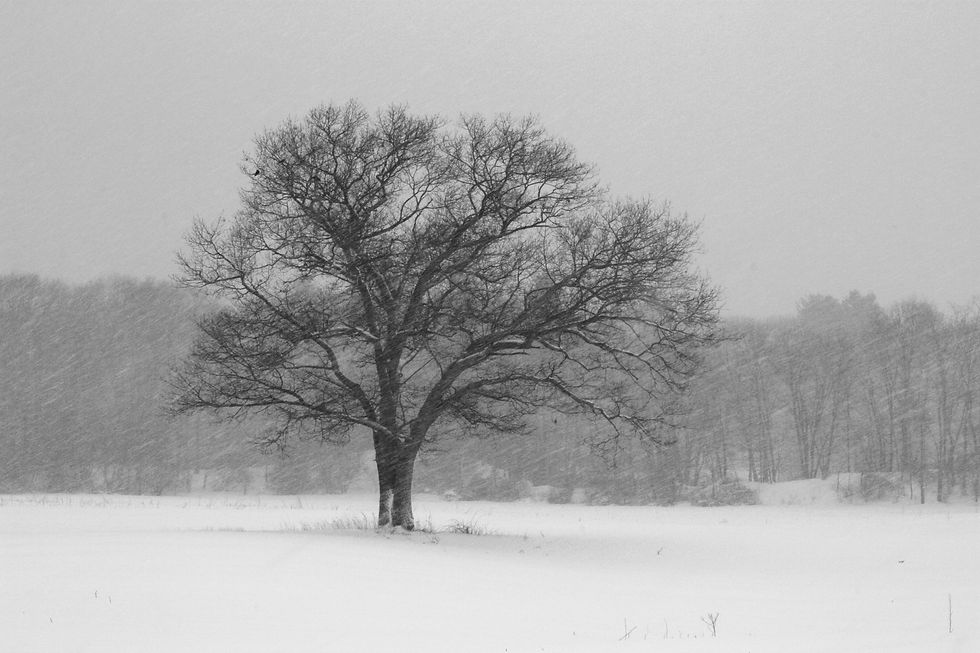
Snow began falling long before Harold Bryson reached the edge of the old forest road, the flakes descending in slow, hypnotic spirals—too slow, almost deliberate. By the time he pulled his car to a stop, the drifts were already piling high, swallowing the tires, threatening to bury him right where he sat.
Beyond the windshield loomed the Winter House.
He had not seen it in thirteen years.
And it seemed to remember.
Its windows were black pits in a face that once felt warm. The roofline sagged like tired shoulders. Frost crusted the porch railing in jagged, fang-like points. The house looked less like a home and more like something that had survived without him—resentfully.
Harold hesitated—one hand on the door handle, the other clutching a paper from the lawyer: Retrieve final effects left by Margaret Bryson before estate closure.
Just one box. That was all.
The snow intensified, thickening the world into a white blur. He had nowhere else to go. And so he stepped out.
I. The House That Breathes in the Dark
Inside, the Winter House exhaled a wave of cold that felt like stepping into a grave.
The power was disconnected, so Harold flicked on his flashlight. The beam cut through the stale dark, illuminating a narrow hallway lined with clocks. Dozens—each one mismatched, each one ticking at a different tempo.
Tick. Tick-tick.
Tick… tick… tick-tick-tick.
The sound writhed like insects under the floorboards.
Harold swallowed hard. “Gran, you really kept all of this?”
The house swallowed his voice.
He moved down the hall, boots creaking against warped floorboards. The smell was wrong—damp wood, unearthed soil, and beneath it, faintly, the sweet murmur of peppermint tea.
Impossible. She hadn’t made tea in years before she died.
He reached the parlor doorway—and froze.
The long dining table was set for Christmas.
Not warmly. Not lovingly.
Meticulously.
Silver polished to an unsettling mirror shine.
Place cards written in his grandmother’s looping script.
Each seat held a wooden toy: a horse, a doll, a soldier.
All his.
He had forgotten how many Christmases he’d missed.
As Harold approached the table, the flashlight flickered. The toys seemed to shift where they sat, leaning toward him, their shadows stretching over the linen like reaching hands.
His chest tightened.
He wasn’t ready to remember. Not all of it. Not yet.
II. The Footsteps in the Hall
When the flashlight died, the darkness sealed him in.
No dim outline. No moon through the window.
Just a thick, suffocating void.
But he wasn’t alone in it.
A footstep sounded in the hallway behind him.
Slow. Dragging. Familiar.
Harold’s throat closed.
His grandmother’s shuffle.
“Gran…?” His voice was barely a breath.
Another step. Closer.
In the blackness, he felt something pass by him—cold, feather-light, brushing his sleeve. He flinched, heart slamming against his ribs.
“Please… I just came for the box.”
The clocks all ticked faster.
Faster.
Faster.
He stumbled backward until his spine hit the wall. Something clattered in the dark—one of the wooden toys falling from its chair.
The footsteps retreated down the hall, slow and beckoning.
Whether from guilt, fear, or something deeper and more broken, Harold followed.
III. The Room of Kept Things
The sewing room glowed with a soft, golden light.
There was no source for it.
It simply… existed.
As though the house itself remembered how to glow, once upon a time.
In the center of the table sat a small wooden box tied with red twine. The air smelled of peppermint and old perfume.
Harold’s chest twisted painfully.
He lifted the box, fingers trembling. It was warm, as if recently held.
Inside lay a single clock.
Black casing.
Silver hands.
Frozen at 12:00.
A folded note rested beneath.
He opened it.
“Time does not heal.
It only keeps.
And you have kept too much, my boy.”
Harold felt the room tilt. His palms slickened with sweat. He wasn’t sure he was breathing.
The golden light dimmed—then pulsed. Once.
Twice.
He backed up, but a soft thump sounded behind him.
A figure stood in the doorway.
Small. Stooped. Gray hair frizzing like frost.
His grandmother.
But her face… her face was wrong.
Features half-formed, like a memory smeared by trembling hands.
Eyes hollow. No pupils. Only swirling darkness.
She raised a hand toward him—slowly, stiffly, like her joints were stuck in place by centuries of cold.
“Harold…”
Her voice was layered—hers, and something deeper beneath, like ice shifting on a frozen lake.
He stepped back. “You’re not real.”
“Real enough.”
She took another step. The floor groaned violently beneath her, as though recoiling from her weight.
Harold clutched the clock to his chest. “I—I didn’t mean to stay away. You know that, don’t you? I was so busy. I— I didn’t think—”
A smile stretched across her ruined face.
Not warm.
Not kind.
“You told yourself that to sleep at night.”
The clocks around them began to ring—each a different hour, chiming over each other in an agonizing cacophony.
Harold dropped to his knees, hands clamped over his ears.
“Stop—please, just stop—”
But his grandmother—whatever wore her shape—leaned down until her hollow eyes filled his vision.
“Time keeps.”
Her voice fractured like breaking branches.
“And it has kept you. Here. With me.”
IV. Midwinter’s Claim
The clocks stopped all at once.
A silence fell so deep it seemed to press on Harold’s lungs.
When he looked up, the chamber was gone.
He stood in the parlor again.
Snow fell softly against the window.
The house looked warm.
Familiar.
His grandmother sat in her rocking chair, humming a Christmas hymn.
“Come here, Harold,” she said kindly.
Her voice—so normal—made his knees weak.
He approached. Tears blurred his vision. It felt like stepping into a memory softened by the mind to survive it.
She reached out, cupping his cheek with a warm palm.
“You’re home,” she whispered.
He leaned into her hand.
The warmth vanished instantly—turning to biting cold.
When he opened his eyes, her face was inches from his—gray, hollow, wrong—and her fingers dug into his skin like talons.
“You’re home,” she repeated, but the voice was no longer hers.
And the house… the house groaned in approval.
Harold tried to scream.
The darkness swallowed it whole.
V. What the House Keeps
Days passed.
Or hours.
Or years.
Time had no meaning in the Winter House.
It only kept.
The clocks began ticking again—slow, uneven, satisfied.
Snow continued falling outside, burying the road, then the car, then everything beyond the property line. The Winter House liked its collection untouched.
In the sewing room, the wooden box remained open.
The clock inside still read 12:00.
Frozen.
Waiting.
Upstairs, if one were to listen closely, one might hear the soft creak of a rocking chair.
And a voice humming a Christmas hymn just slightly out of tune.
The same voice that answered if you whispered in the dark:
“Harold can’t come to the door now.”


Comments